 |
|


 |
 |
 |
 |
 |
 |


The low-downs on the how tos
The most common mistake that people make is "camera shake". This happens when your hand was not steady when you take the photos. Or, it happens when you depress the shutter with too much force. Everybodys hands shakes. Taking a deep breath, exhaling half of it and holding your breath before depressing on the shutter will help, but it does not totally eliminate the hand shaking. Another contributing factor towards the camera shaking is the method used when depressing the shutter. The shutter should be depressed gently to minimise the chances of the camera moving. When taking a photo of a person, the place to aim for would be the eyes. Normally, when viewing a portrait photo, the first place that the person would look at is the eyes. It generally said that a good portrait photo is one where the eyes are sharp. When you find difficulty in focusing at the eyes, the next best place is to focus on the face. Taking a landscape photograph is a lot easier. Most compact cameras treat anything further than 1.5 metres as infinity. Thus, it would not make any difference if you focus on an object that is 2 metres or 20 metres away, the photo would still turn out sharp. Composition of an image is a very important part of photography. After all, the photo would not look right if part of the persons head were cropped off. The main thing to note here, is that youll have to find out how much you see in the viewfinder is printed onto the negative. Some of the viewfinders are only about 90%, which means that what you see is not what you get. Youll get a bit more (or sometimes less) than what was seen through the viewfinder. To find out how much coverage you get from your viewfinder, you should either read the instruction manual, or ask the salesperson when purchasing the camera. Another thing to note on compact cameras is the location of the viewfinder. As the viewfinder is in fact situated above the lens (or on the side if held vertically), it would mean that the image youre taking would in fact be slightly lower than what you see. Most compact cameras come with an automatic built-in flash. This means that the camera will have a light meter and when there is not enough light, the flash will be activated. In some models, the user will be able to manually select whether he/she wants the flash to be on or off and a few other flash options. One of the main problems of automatic flash is taking a photo of a person against a bright background. To the camera, there is sufficient light and the flash will not be triggered. The photo will turn out with the person being dark (sometimes only the silhouette of the person is seen) and the background bright. Manually select the flash to be activated when in this situation. 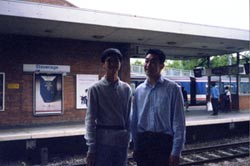 Camera was tricked by the bright background and the flash was not activated. Another problem with using automatic flash is that the flash would probably have a range of only five meters, and your subject is more than five meters away. That said, it would mean that the subject does not get properly lit and the subject will come out dark. The solution to this is to use film of higher speed. More on that later. When on a holiday, it is advisable to take more than one shot of a given place. After all, it is a lot cheaper to pay the cost for printing an extra shot, instead of having to travel there again if the photo doesnt turn out. When in doubt, just take again. If you feel that your hand shook when the shot was taken, take again. This minimises the chances that you will end up with a bad photo of a particular place. |